
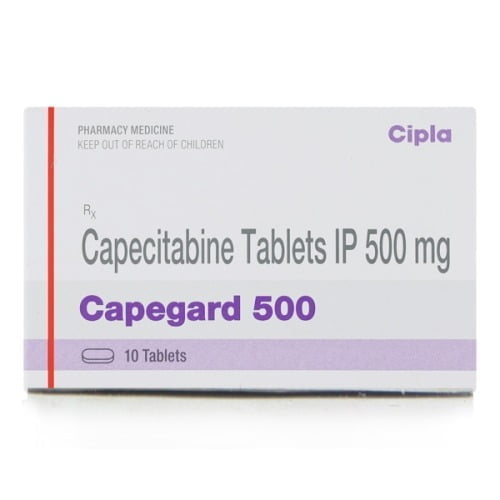
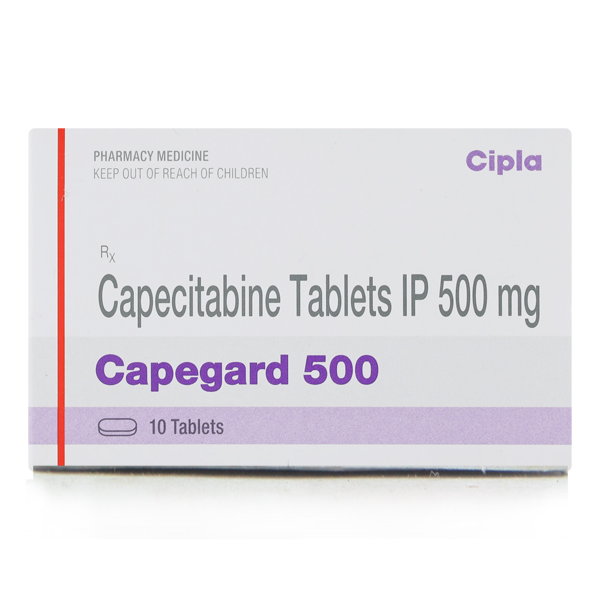
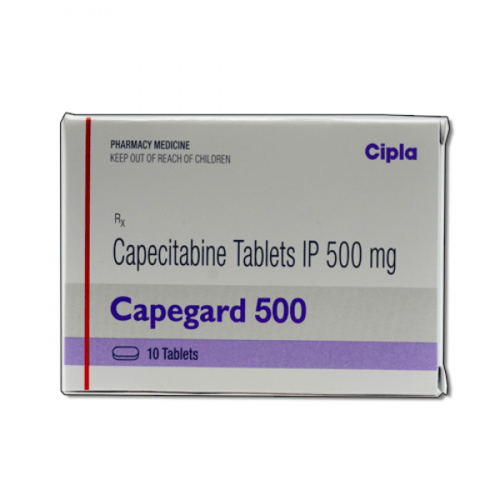
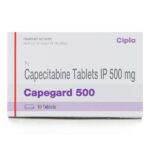

Buy Capegard 500 @399
Capegard 500 Information:
SALT COMPOSITION: Capecitabine (500mg)
Capegard 500 Tablet is used in the treatment of cancer of breast, colon, and rectum. It may be also used to treat other conditions, as determined by the doctor. It is used alone or in combination with some other medicine as a part of chemotherapy.
Capegard 500 Tablet should be taken with food within 30 minutes after eating a meal. Your doctor will decide what dose is necessary and how often you need to take it. This will depend on what you are being treated for and may change from time to time. You should take it exactly as your doctor has advised. Taking it in the wrong way or taking too much can cause very serious side effects. It may take several weeks or months for you to see or feel the benefits but do not stop taking it unless your doctor tells you to.
The most common side effects of this medicine include vomiting, weakness, nausea, abdominal pain, and diarrhea. This medicine may reduce the number of blood cells (decrease white blood cells) in your blood, thereby, increasing the susceptibility to infections. Regular blood tests are required to check your blood cells along with heart, liver, and blood uric acid levels.
Before taking it, tell your doctor if you have liver, or kidney problems or are taking any medicines to treat infections. Many other medicines can affect, or be affected by, this medicine so let your doctor know all medications you are using. This medicine is not recommended during pregnancy or while breastfeeding. The use of effective contraception by both males and females during treatment is important to avoid pregnancy.
USES OF CAPEGARD 500
Capegard 500mg Tablet is primarily used in the treatment of colorectal cancer, breast cancer, and gastric cancer. It is an effective chemotherapy drug that helps to slow down or stop the growth of cancer cells.
BENEFITS OF CAPEGARD 500
Capegard 500 Tablet helps to treat breast cancer and it may be used alone or in combination with other medicines or treatment modalities like chemotherapy. It relieves the symptoms of breast cancer such as breast lumps, bloody discharge from nipples or changes in the shape or texture of the breast. Capegard 500 Tablet kills or stops the growth of cancer cells and also prevents the multiplication of cancer cells. Discuss with your doctor if any of the side effects bother you.
Capegard 500mg Tablet offers several medicinal benefits for patients undergoing cancer treatment. It can help to reduce the size of tumors, prevent cancer from spreading to other parts of the body, and improve overall survival rates in certain types of cancer.
SIDE EFFECTS OF CAPEGARD 500
Most side effects do not require any medical attention and disappear as your body adjusts to the medicine. Consult your doctor if they persist or if you’re worried about them
Common side effects of Capegard 500
- Vomiting
- Weakness
- Nausea
- Abdominal pain
- Diarrhea
- Blisters on fingers/feet
HOW TO USE CAPEGARD 500
It is important to follow the directions provided by your healthcare professional when taking Capegard 500mg Tablet. The dosage and duration of treatment may vary depending on your specific condition and response to the medication. Take the tablet orally with a full glass of water, preferably within 30 minutes after a meal. Do not crush or chew the tablet, as it is designed to release the medication slowly.
Capegard 500 Storage
Store Capegard 500mg Tablet at room temperature, away from direct sunlight and moisture. Keep it out of reach of children and pets. Do not use the medication if the expiry date has passed or if the packaging is damaged.
Capegard 500 Drug Warnings
Capegard 500mg Tablet should not be used by patients who are allergic to capecitabine or any of the other ingredients in the medication. It is also important to inform your doctor about any other medical conditions you have, such as liver or kidney problems, or a history of heart disease. Your doctor will need to adjust the dosage or monitor your condition closely to ensure the medication is safe for you.
Capegard 500 Drug Interactions
Capegard 500mg Tablet may interact with other medications, including blood thinners, antacids, and certain antibiotics. It is important to inform your doctor about all the medications you are currently taking, including over-the-counter drugs and herbal supplements, to avoid any potential interactions.
Capegard 500-Drug Interactions Checker List: Safety Advice
When taking Capegard 500mg Tablet, it is essential to follow the safety advice provided by your healthcare professional. This includes attending regular check-ups, monitoring your blood counts, and reporting any unusual symptoms or side effects. Your doctor may also recommend certain lifestyle changes, such as maintaining a healthy diet and avoiding excessive sun exposure.
HOW CAPEGARD 500 WORKS
Capegard 500 Tablet is an anticancer medication. Inside the body, this medicine gets converted into 5-fluorouracil (chemical). This chemical hampers the synthesis of genetic materials (RNA and DNA) in the cancer cells, thereby interferes with their growth. This slows down the growth of cancer cells and eventually kills them.
SAFETY ADVICE
warnings
 Alcohol CAUTION
CONSULT YOUR DOCTOR
It is not known whether it is safe to consume alcohol with Capegard 500 Tablet. Please consult your doctor.
warnings
 Pregnancy CAUTION
CONSULT YOUR DOCTOR
Capegard 500 Tablet is unsafe to use during pregnancy as there is definite evidence of risk to the developing baby. However, the doctor may rarely prescribe it in some life-threatening situations if the benefits are more than the potential risks. Please consult your doctor.
warnings
 Breastfeeding CAUTION
UNSAFE
Capegard 500 Tablet is unsafe to use during breastfeeding. Data suggests that the drug may cause toxicity to the baby.
warnings
 Driving CAUTION
UNSAFE
Capegard 500 Tablet may decrease alertness, affect your vision or make you feel sleepy and dizzy. Do not drive if these symptoms occur.
warnings
 Kidney CAUTION
Capegard 500 Tablet should be used with caution in patients with kidney disease. Dose adjustment of Capegard 500 Tablet may be needed. Please consult your doctor.
Use of Capegard 500 Tablet is not recommended in patients with severe kidney disease.
warnings
 Liver CAUTION
Capegard 500 Tablet should be used with caution in patients with liver disease. Dose adjustment of Capegard 500 Tablet may be needed. Please consult your doctor.
Use of Capegard 500 Tablet is not recommended in patients with severe kidney disease.
warning
 CHILDREN CAUTION
UNSAFE
Capegard 500 Tablet is not recommended for use in children and adolescents below 18 years.
 Capegard 500 Habit Forming

Capegard 500mg Tablet is not habit-forming. It is a prescription medication that should only be used under the guidance of a healthcare professional.
 Diet
Diet

While taking Capegard 500mg Tablet, it is important to maintain a healthy and balanced diet. Eating a variety of fruits, vegetables, whole grains, and lean proteins can help support your overall health and well-being during cancer treatment.
Remember, Capegard 500mg Tablet is a powerful medication that should only be used as prescribed by your doctor. If you have any questions or concerns about your treatment, do not hesitate to reach out to your healthcare professional for guidance.
 expert advice
- Capegard 500 Tablet is used alone or in combination with other medicines for the treatment of colon, rectum or breast cancers.
- It is oral chemotherapy, hence it is preferred by many patients.
- It should be taken within 30 minutes after eating a meal.
- The dose and the number of treatment cycles needed will depend on the type and stage of cancer that is being treated.
- It may cause dizziness and tiredness. Don’t drive or do anything requiring concentration until you know how it affects you.
- Frequency of hair loss is much less compared to other chemotherapy drugs.
- Do not take it if you are pregnant or breastfeeding.
- Your doctor may regularly monitor your blood cells during treatment with this medicine. Inform your doctor immediately if you notice signs of infection such as fever, sore throat, rash or severe diarrhea.
- Inform your doctor immediately if you start to have side effects such as diarrhea, vomiting, nausea, mouth sores, chest pain or loss of appetite.
FAQs ABOUT CAPEGARD 500
Q: What should I inform my doctor before starting with CAPEGARD 500?
A: Before starting the treatment with CAPEGARD 500MG TABLET you should inform your doctor if you have kidney, liver or heart disease, diarrhea, dehydration, nausea and vomiting, brain disease (Ex. cancer that has spread to the brain or nerve damage (neuropathy), diabetes, history of eye problems or severe skin reactions.
Q: What if I forget to take a dose of CAPEGARD 500?
A: If you have missed a dose, take it as soon as you remember it. Do not take double dose to compensate for the missed dose of CAPEGARD 500MG TABLET. Continue taking the medicine as per your schedule. Talk to your doctor.
Q: Is CAPEGARD 500 a form of chemotherapy?
A: Yes. CAPEGARD 500MG TABLET is an oral chemotherapy medicine which is used in the treatment of cancers like rectal, colon, gastric or breast cancer. Your doctor will decide the correct treatment plan for you.
Q: How long do I have to take CAPEGARD 500?
A: Your doctor will decide the correct dose of CAPEGARD 500MG TABLET and number of cycles for you depending upon your body weight, age and disease condition. CAPEGARD 500MG TABLET are usually taken for 14 days followed by a 7-day rest period. This 21-day period is one treatment cycle. In some cases, you will advise to take CAPEGARD 500MG TABLET every day while used in combination with other medicines.
Q: Can I stop taking CAPEGARD 500 if I feel better?
A: No. You should not stop taking CAPEGARD 500MG TABLET or change the dose until and unless your doctor asks you to. You will at a high risk of getting back the symptoms and dangerous tumor growth. Talk to your doctor.
Q: Can CAPEGARD 500 cause eye problems?
A: Prior to starting the treatment with CAPEGARD 500MG TABLET, you should inform your doctor if you have a history of eye problems. While your treatment with CAPEGARD 500MG TABLET you may need monitoring of your eyes. Talk to your doctor before taking CAPEGARD 500MG TABLET.
Q: Does CAPEGARD 500 shrink tumours?
A: No, CAPEGARD 500MG TABLET does not shrink tumours. CAPEGARD 500MG TABLET contains capecitabine, which works by stopping or reducing the abnormal growth of cells which is called a cytostatic activity. Only after being absorbed by the body, it is changed into an active anti-cancer medicine (more in tumor tissue than in normal tissue). Therefore, it stops tumor growth and spreading without causing them to shrink.
Q: Do CAPEGARD 500 cause hair loss?
A: Yes, the most common side effect of CAPEGARD 500MG TABLET is hair loss. Before your cancer treatment, prepare in advance for changes in your hair. Talk to your doctor about what to expect. Use head coverings such as wig, scarf. Try to add iron and protein rich foods like green leafy vegetables and beans into snacks and meals.
Q: Can I take double doses together to cure cancer soon?
A: No, do not take more CAPEGARD 500MG TABLET than the normal recommended dose as it may cause overdosage of CAPEGARD 500MG TABLET leading to harmful side effects such as diarrhea, inflammation of gut or mouth, pain or bleeding in stomach or bone marrow depression (reduction in blood cells), nausea and vomiting.
Q: what is the capegard 500 price in india?
Here are more 25 frequently asked questions about Capegard 500 Tablet, based on information from medical websites and official drug information sources.
Capegard 500 Tablet is an anti-cancer medication used to treat breast cancer, colon cancer, and rectal (colorectal) cancer.
2. What is the composition of Capegard 500 Tablet?
Capegard 500 Tablet contains the active ingredient Capecitabine (500 mg). It is manufactured by Cipla Ltd.
3. How does Capegard 500 Tablet work?
Capegard 500 Tablet is an anticancer medication. Inside the body, it gets converted into 5-fluorouracil, a chemical that interferes with the synthesis of genetic materials (RNA and DNA) in cancer cells, slowing down their growth and eventually killing them.
4. Is Capegard 500 Tablet a form of chemotherapy?
Yes. Capegard 500 Tablet is an oral chemotherapy drug classified as an “antimetabolite.” It is used alone or in combination with other medicines as part of a chemotherapy regimen.
5. How should I take Capegard 500 Tablet?
Take this medicine exactly as prescribed by your doctor. Swallow the tablet whole with a glass of water—do not chew, crush, or break it. Take it within 30 minutes after finishing a meal.
6. When is the best time to take Capegard 500?
The tablet should be taken twice daily (approximately 12 hours apart), once in the morning and once in the evening, within 30 minutes after a meal. Taking it with food helps improve absorption and reduce stomach side effects.
7. What are the common side effects of Capegard 500?
Common side effects include nausea, vomiting, diarrhea, weakness/fatigue, loss of appetite, abdominal pain, hair loss, hand-foot syndrome (redness/swelling on palms and soles), mouth inflammation (stomatitis), and decreased blood cell counts.
8. What is Hand-Foot Syndrome?
Hand-foot syndrome is a common side effect of Capegard 500 characterized by redness, swelling, pain, peeling, or blistering on the palms of the hands and soles of the feet. If you experience these symptoms, inform your doctor immediately.
9. Does Capegard 500 Tablet cause hair loss?
Yes, hair loss is a possible side effect, though the frequency of hair loss with capecitabine is generally much less compared to other chemotherapy drugs.
10. Can pregnant women take Capegard 500 Tablet?
No. Capegard 500 Tablet is highly unsafe during pregnancy and can cause serious harm to the unborn baby, including birth defects and pregnancy loss. Do not use this medicine if you are pregnant or planning to become pregnant.
11. Do I need to use birth control while taking this medicine?
Yes. Women who can become pregnant should use effective birth control during treatment and for 6 months after the final dose. Men taking this medicine whose partners can become pregnant should use contraception during treatment and for 3 months after the final dose.
12. Can I take Capegard 500 Tablet while breastfeeding?
No. Capegard 500 Tablet is unsafe to use during breastfeeding as it may pass into breast milk and cause toxicity to the nursing baby. Do not breastfeed during treatment and for 2 weeks after the final dose.
13. Can I drink alcohol while taking Capegard 500?
It is not known whether it is safe to consume alcohol with Capegard 500 Tablet. Please consult your doctor for specific advice.
14. Can I drive after taking Capegard 500 Tablet?
This medicine may decrease alertness, affect your vision, or make you feel sleepy and dizzy. Do not drive or operate heavy machinery if you experience these symptoms.
15. How long do I need to take Capegard 500 Tablet?
Treatment is typically given in cycles of 21 days. Capegard 500 is usually taken for 14 days followed by a 7-day rest period. Continue taking this medicine for the duration prescribed by your doctor.
16. What should I do if I miss a dose?
If you miss a dose, skip it and continue with your next scheduled dose. Do not take a double dose to make up for a missed one. Do not take an additional dose after vomiting—continue with the next scheduled dose.
17. Can Capegard 500 Tablet interact with blood thinners?
Yes. Taking Capegard 500 with blood thinners like warfarin can cause changes in how fast your blood clots and can lead to serious, even fatal, bleeding. If you take warfarin, your doctor should monitor your INR more frequently.
18. What is DPD deficiency and why does it matter?
DPD (dihydropyrimidine dehydrogenase) deficiency is a metabolic disorder that affects how your body breaks down capecitabine. Patients with complete DPD deficiency are at increased risk for severe, life-threatening toxic reactions. Tell your doctor if you know you have this condition.
19. Can Capegard 500 affect my heart?
Yes. Cardiotoxicity can occur with capecitabine, including heart attack, chest pain, irregular heartbeat, and heart failure. This may be more common in patients with a history of coronary artery disease. Seek immediate medical help for new chest pain or shortness of breath.
20. Do I need regular blood tests while taking Capegard 500?
Yes. Your doctor will regularly monitor your complete blood count (CBC), as well as liver and kidney function, to check for side effects and ensure the medicine is working safely.
21. Can people with kidney problems take Capegard 500?
Capegard 500 should be used with caution in patients with kidney disease. For patients with moderate renal impairment (creatinine clearance 30-50 mL/min), a 25% dose reduction is recommended. It is not recommended in patients with severe kidney disease.
22. What serious side effects should I watch for?
Seek immediate medical help if you experience: grade 2 or higher diarrhea (4-6 extra stools/day), severe bloody diarrhea with fever, mouth sores making eating difficult, hand-foot syndrome affecting daily activities, chest pain, shortness of breath, fever of 100.5°F or higher, or signs of bleeding (unusual bruising, black/tarry stools, blood in urine).
23. What is the price of Capegard 500 Tablet in India?
The Maximum Retail Price (MRP) for a strip of 10 tablets is approximately ₹854. Prices may vary depending on the pharmacy and location; some sources list it around ₹710-₹330 per strip.
24. Are there any special precautions for handling this medication?
Capecitabine is a cytotoxic drug. If the tablet needs to be crushed or cut, it should be done by a trained professional using appropriate safety equipment. Keep the medicine away from children. Dispose of any unused product according to local requirements or drug take-back programs.
25. What is the most important information I should know about Capegard 500?
The most important information is that Capegard 500 can interact with blood thinners like warfarin, causing serious bleeding that can lead to death. Also, it can cause severe diarrhea, hand-foot syndrome, and heart problems. Always take it exactly as prescribed, never crush or cut the tablets, and contact your doctor immediately if you develop severe side effects.
Disclaimer: This information is for educational purposes only and does not constitute medical advice. Always consult your oncologist or healthcare provider for medical advice, diagnosis, or treatment related to your condition.
REFERENCES:
- KD. Tripathi. Chemotherapy of Neoplastic Diseases. Essentials of medical pharmacology. Seventh edition. 2013. Page – 864.
- Sedat Tatar, Can E. Yalçin, Billur Sezgin, Ayse Y. Tas, Orkun Müftüoglu, Selahattin Özmen. Capecitabine-Induced Bilateral Ectropion: A Rare Ocular Manifestation Requiring Surgical Intervention. National Institute of Health NLM, National Centre for Biotechnology Information. PubMed Central. 2018 Oct-Dec. [Accessed on 18th June 2022] https://www.ncbi.nlm.nih.gov/pmc/articles/PMC6371725/
- Walko CM, Lindley C. Capecitabine: a review. National Institute of Health NLM, National Centre for Biotechnology Information. PubMed.gov. January 2005. [Accessed on 18th June 2022] https://pubmed.ncbi.nlm.nih.gov/15763604/
- Glenmark Pharmaceuticals s.r.o. Electronic Medicines Compendium (EMC). [Revised in May 2022] [Accessed on 18th June 2022] https://www.medicines.org.uk/emc/files/pil.9938.pdf
- Hawke’s Bay District Health Board. Capecitabine. March 2018. [Accessed on 18th June 2022] https://hawkesbay.health.nz/assets/Patient-Medication-Information/Capecitabine-PIL-Booklet.pdf
- Drug bank. Capecitabine. [Accessed on 18th June 2022] https://go.drugbank.com/drugs/DB01101



There are no reviews yet.