
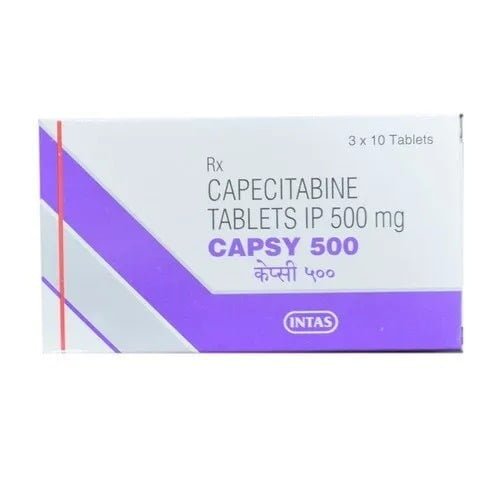
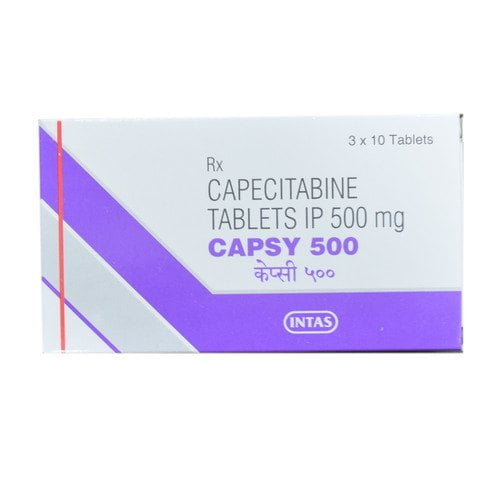
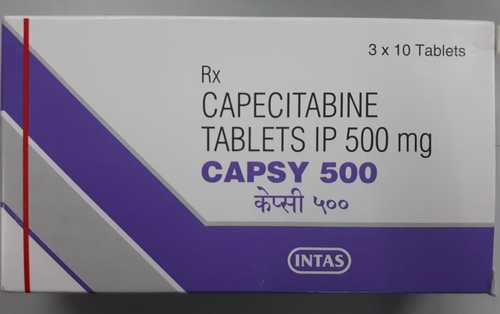
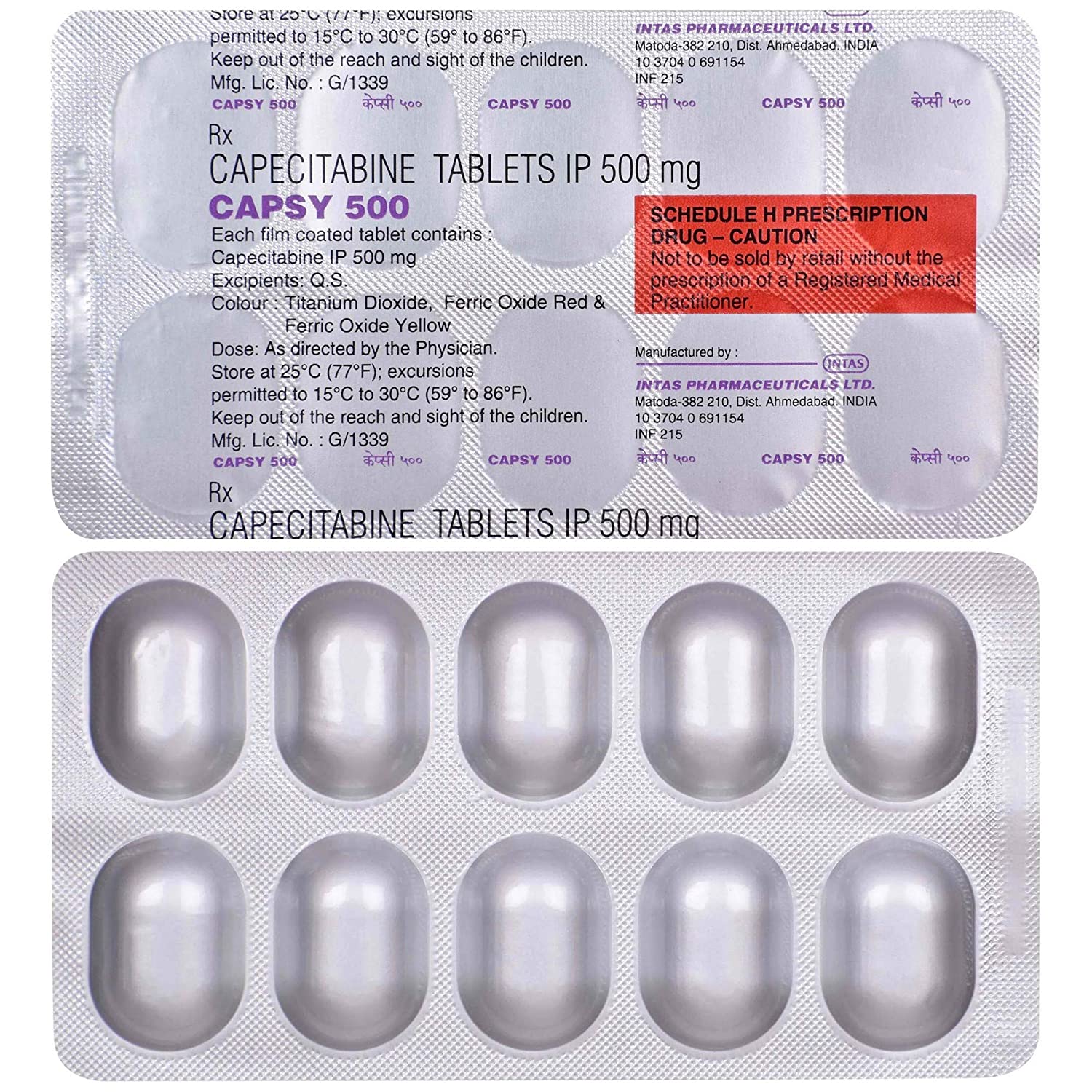
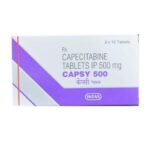
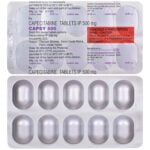
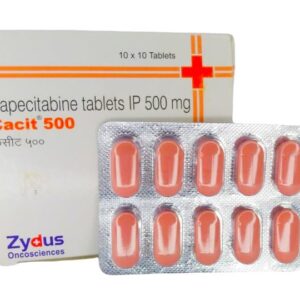

Buy Capsy 500 Only @299
About Capsy 500
SALT COMPOSITION: Capecitabine (500mg)
Capsy 500mg Tablet is used in the treatment of cancer of breast, colon, and rectum. It may be also used to treat other conditions, as determined by the doctor. It is used alone or in combination with some other medicine as a part of chemotherapy.
Capsy 500mg Tablet should be taken with food within 30 minutes after eating a meal. Your doctor will decide what dose is necessary and how often you need to take it. This will depend on what you are being treated for and may change from time to time. You should take it exactly as your doctor has advised. Taking it in the wrong way or taking too much can cause very serious side effects. It may take several weeks or months for you to see or feel the benefits but do not stop taking it unless your doctor tells you to.
The most common side effects of this medicine include vomiting, weakness, nausea, abdominal pain, and diarrhea. This medicine may reduce the number of blood cells (decrease white blood cells) in your blood, thereby, increasing the susceptibility to infections. Regular blood tests are required to check your blood cells along with heart, liver, and blood uric acid levels.
Before taking it, tell your doctor if you have liver, or kidney problems or are taking any medicines to treat infections. Many other medicines can affect, or be affected by, this medicine so let your doctor know all medications you are using. This medicine is not recommended during pregnancy or while breastfeeding. The use of effective contraception by both males and females during treatment is important to avoid pregnancy.
USES OF CAPSY 500
Capsy 500mg Capecitabine (500mg) TABLET is indicated for the treatment of various types of cancer. It works by interfering with the growth and spread of cancer cells in the body. Your doctor will determine the appropriate dosage and treatment duration based on your specific condition.
BENEFITS OF CAPSY 500
Capsy 500mg Tablet helps to treat breast cancer and it may be used alone or in combination with other medicines or treatment modalities like chemotherapy. It relieves the symptoms of breast cancer such as breast lumps, bloody discharge from nipples or changes in the shape or texture of the breast. Capsy 500mg Tablet kills or stops the growth of cancer cells and also prevents the multiplication of cancer cells. Discuss with your doctor if any of the side effects bother you.
Medicinal Benefits of CAPSY 500
Capsy 500mg Tablet Capecitabine (500mg) TABLET offers several medicinal benefits for cancer patients. It helps to slow down or stop the growth of cancer cells, reducing the size of tumors and preventing them from spreading to other parts of the body. This medication can improve the overall survival rate and quality of life for individuals undergoing cancer treatment.
CAPSY 500 Directions for Use
Capsy 500mg Tablet Capecitabine (500mg) TABLET should be taken orally, with or without food, as directed by your healthcare provider. It is usually taken twice a day, in the morning and evening. Swallow the tablet whole with a glass of water. Do not crush, chew, or break the tablet unless instructed by your doctor.
CAPSY 500 Storage
Store Capsy 500mg Tablet Capecitabine (500mg) TABLET at room temperature, away from moisture and heat. Keep it out of reach of children and pets. Do not use this medication after the expiration date mentioned on the packaging.
Side Effects of CAPSY 500
Like any other medication, Capsy 500mg Tablet Capecitabine (500mg) TABLET may cause side effects. Common side effects include nausea, vomiting, diarrhea, loss of appetite, tiredness, and hand-foot syndrome (redness, swelling, and pain on the palms of the hands and soles of the feet). If you experience severe or persistent side effects, contact your doctor immediately.
CAPSY 500 Drug Warnings
Capsy 500mg Tablet Capecitabine (500mg) TABLET should only be used under the supervision of a qualified healthcare professional. Inform your doctor about any existing medical conditions, allergies, or medications you are currently taking. This medication may not be suitable for individuals with certain liver or kidney problems.
CAPSY 500 Drug Interactions
Capsy 500mg Tablet Capecitabine (500mg) TABLET may interact with other medications, including blood thinners, antacids, and certain antibiotics. It is important to inform your doctor about all the medications you are taking to avoid any potential interactions.
CAPSY 500-Drug Interactions Checker List: Safety Advice
Before starting Capsy 500mg Tablet Capecitabine (500mg) TABLET, consult your doctor or pharmacist for a comprehensive list of potential drug interactions. They can provide you with safety advice and guidance on how to minimize the risk of adverse reactions.
Common side effects of Capsy 500
- Vomiting
- Weakness
- Nausea
- Abdominal pain
- Diarrhea
- Blisters on fingers/feet
HOW TO USE CAPSY 500
Take this medicine in the dose and duration as advised by your doctor. Swallow it as a whole. Do not chew, crush or break it. Capsy 500mg Tablet is to be taken with food.
HOW CAPSY 500 WORKS
Capsy 500mg Tablet is an anticancer medication. Inside the body, this medicine gets converted into 5-fluorouracil (chemical). This chemical hampers the synthesis of genetic materials (RNA and DNA) in the cancer cells, thereby interferes with their growth. This slows down the growth of cancer cells and eventually kills them.
SAFETY ADVICE
warnings
 Alcohol
CONSULT YOUR DOCTOR
It is not known whether it is safe to consume alcohol with Capsy 500mg Tablet. Please consult your doctor.
warnings
 Pregnancy
CONSULT YOUR DOCTOR
Capsy 500mg Tablet is unsafe to use during pregnancy as there is definite evidence of risk to the developing baby. However, the doctor may rarely prescribe it in some life-threatening situations if the benefits are more than the potential risks. Please consult your doctor.
warnings
 Breastfeeding
UNSAFE
Capsy 500mg Tablet is unsafe to use during breastfeeding. Data suggests that the drug may cause toxicity to the baby.
warnings
 Driving
UNSAFE
Capsy 500mg Tablet may decrease alertness, affect your vision or make you feel sleepy and dizzy. Do not drive if these symptoms occur.
warnings
 Kidney
CAUTION
Capsy 500mg Tablet should be used with caution in patients with kidney disease. Dose adjustment of Capsy 500mg Tablet may be needed. Please consult your doctor.
Use of Capsy 500mg Tablet is not recommended in patients with severe kidney disease.
warnings
 Liver
Liver
CAUTION
Capsy 500mg Tablet should be used with caution in patients with liver disease. Dose adjustment of Capsy 500mg Tablet may be needed. Please consult your doctor.
Use of Capsy 500mg Tablet is not recommended in patients with severe kidney disease.
Capsy 500mg Tablet Habit Forming:
Capsy 500mg Tablet is not habit-forming. It is a prescription medication that should be used only as directed by your doctor.
More About Cpsy 500
- Capsy 500mg Tablet is used alone or in combination with other medicines for the treatment of colon, rectum or breast cancers.
- It is oral chemotherapy, hence it is preferred by many patients.
- It should be taken within 30 minutes after eating a meal.
- The dose and the number of treatment cycles needed will depend on the type and stage of cancer that is being treated.
- It may cause dizziness and tiredness. Don’t drive or do anything requiring concentration until you know how it affects you.
- Frequency of hair loss is much less compared to other chemotherapy drugs.
- Do not take it if you are pregnant or breastfeeding.
- Your doctor may regularly monitor your blood cells during treatment with this medicine. Inform your doctor immediately if you notice signs of infection such as fever, sore throat, rash or severe diarrhea.
- Inform your doctor immediately if you start to have side effects such as diarrhea, vomiting, nausea, mouth sores, chest pain or loss of appetite.
FAQs
Q. What are the side effects of Capsy 500mg Tablet?
A: The side effects of Capsy 500mg Tablet include stomach pain or upset stomach, constipation, loss of appetite, and change in ability to taste food. It may also cause increased thirst, unusual tiredness or weakness, dizziness, headache, hair loss, skin rash, back, join, or muscle pain. You may also experience red, swollen, itchy, or teary eyes and trouble falling asleep or staying asleep. Inform your doctor if any of these symptoms are severe and persist for long.
Q. What are the serious side effects of Capsy 500mg Tablet?
A: The use of Capsy 500mg Tablet may cause various serious side effects such as diarrhea, nausea, vomiting, sores in the mouth, swelling, pain, redness, or peeling of skin on the palms and soles of the feet. One may also experience fever, chills, sore throat, or other signs of an infection, swelling of the hands, feet, ankles, or lower legs, chest pain or pressure, fast heartbeat, dark urine and yellowing of the skin or eyes. Inform your doctor immediately if you experience any such symptoms.
Q. Does Capsy 500 make you tired?
A: Yes, Capsy 500mg Tablet may make you tired and you may also feel weak, as these are the most common side effects of the medicine. Hence, it is possible that use of Capsy 500mg Tablet may affect your ability to drive or operate machinery.
Q. What is the most important information that I should know about Capsy 500mg Tablet?
A: It is important to know that Capsy 500mg Tablet can interfere with working of blood thinners like warfarin. This type of interference can cause a change in the rate of clot formation and can cause bleeding that can even lead to death. The risk is higher for cancer patients, especially those who are over 60 years of age. Seek immediate medical help if you experience symptoms like unusual bleeding, vomiting or spitting up blood or brown material that resembles coffee grounds, bloody or black, tarry stools, blood in urine, red or dark-brown urine, or easy bruising.
Q. How long do I need to take Capsy 500mg Tablet?
A: The duration of treatment with Capsy 500mg Tablet depends on the nature of your illness and individual response to treatment. Usually, it is given as a series of treatment cycles, each of these cycles lasts for 21 days. Capsy 500mg Tablet is given for 14 days followed by a rest period of 7 days. You should continue taking this medicine for the time prescribed by the doctor.
Q. Do I need to use birth control method while using Capsy 500mg Tablet?
A: Yes, birth control methods are a must while using Capsy 500mg Tablet, as this medicine may harm your unborn child. Females should continue using these methods for 6 months after the final dose. On the other hand, men using these medicines whose partners can become pregnant should use effective birth control during treatment and for 3 months after the final dose.
Q. What kind of drug is Capsy 500mg Tablet?
A: Capsy 500mg Tablet is an anti-cancer (antineoplastic or cytotoxic) chemotherapy drug. Capsy 500mg Tablet is classified as an “antimetabolite.” Capsy 500mg Tablet itself is not a cytostatic medicine; it gets converted into an active anti-cancer medicine (more in tumour tissue than in normal tissue) only after getting absorbed by the body.
Q. Do I need to get any tests done while on Capsy 500mg Tablet?
A: The doctor will check you on a regular basis while you are taking Capsy 500mg Tablet to monitor side effects and your response to therapy. You may need to get your blood test done as advised by the doctor to monitor your complete blood count (CBC) as well as the function of kidneys and liver.
Q. Should Capsy 500 be taken with or without food?
A: Capecitabine should be taken within 30 minutes after finishing a meal. Swallow tablets as a whole (do not cut or crush) with water. Consult your doctor if you cannot take the whole tablet. If Capsy 500mg Tablet needs to be crushed or cut, it should be done by a trained professional using appropriate equipment and safety procedures.
Q: what is the capsy 500 price in india?
A: Its MRP is already reduced but you can get it very cheaply @299 with free shipping cash on delivery no hidden charges with long expiry on hivhub.in
Here are more 25 frequently asked questions about Capsy 500 Tablet, based on information from medical and pharmacy sources.
1. What is Capsy 500 Tablet used for?
Capsy 500 Tablet is an anti-cancer medication used to treat breast cancer, colon cancer, and rectal (colorectal) cancer .
2. What is the composition of Capsy 500 Tablet?
Capsy 500 Tablet contains Capecitabine (500 mg) as its active ingredient . It is manufactured by Intas Pharmaceuticals Ltd .
3. How does Capsy 500 Tablet work?
Capsy 500 Tablet is an anti-cancer (antineoplastic) medication. When taken, the body converts it into 5-fluorouracil, a chemical that interferes with the synthesis of genetic material (DNA and RNA) in cancer cells, slowing down their growth and eventually killing them .
4. Is Capsy 500 Tablet a form of chemotherapy?
Yes. Capsy 500 Tablet is an oral chemotherapy drug classified as an “antimetabolite.” It is used alone or in combination with other medicines as part of a chemotherapy regimen .
5. How should I take Capsy 500 Tablet?
You should take Capsy 500 Tablet within 30 minutes after finishing a meal. Swallow the tablet whole with a glass of water—do not crush, chew, or break it .
6. When is the best time to take Capsy 500?
The tablet should be taken twice daily (or as prescribed by your doctor) within 30 minutes after a meal. Taking it with food helps improve absorption and reduce stomach side effects .
7. What are the common side effects of Capsy 500?
Common side effects include nausea, vomiting, diarrhea, weakness, fatigue, loss of appetite, abdominal pain, hair loss, mouth ulcers, and hand-foot syndrome (redness, swelling, pain, or blisters on palms and soles) .
8. What is Hand-Foot Syndrome?
Hand-foot syndrome is a common side effect of Capsy 500 characterized by redness, swelling, pain, peeling, or blistering on the palms of the hands and soles of the feet. If you experience these symptoms, inform your doctor immediately .
9. Does Capsy 500 Tablet cause hair loss?
Yes, hair loss (alopecia) is a possible side effect, though the frequency of hair loss with capecitabine is generally much less compared to other chemotherapy drugs .
10. Can pregnant women take Capsy 500 Tablet?
No. Capsy 500 Tablet is highly unsafe during pregnancy and can cause serious harm to the unborn baby, including birth defects and pregnancy loss. Do not take this medicine if you are pregnant or planning to become pregnant .
11. Do I need to use birth control while taking this medicine?
Yes. Women who can become pregnant should use effective birth control during treatment and for 6 months after the final dose. Men taking this medicine whose partners can become pregnant should use contraception during treatment and for 3 months after the final dose .
12. Can I take Capsy 500 Tablet while breastfeeding?
No. Capsy 500 Tablet is unsafe to use during breastfeeding as it passes into breast milk and may harm the nursing baby .
13. Can I drink alcohol while taking Capsy 500?
Alcohol consumption is generally considered unsafe during treatment with Capsy 500 Tablet. Consult your doctor for specific advice .
14. Can I drive after taking Capsy 500 Tablet?
This medicine may cause dizziness, drowsiness, and tiredness. Do not drive or operate heavy machinery if you experience these symptoms .
15. How long do I need to take Capsy 500 Tablet?
Treatment is typically given in cycles of 21 days. Capsy 500 is usually taken for 14 days followed by a 7-day rest period. Continue taking this medicine for the duration prescribed by your doctor .
16. What should I do if I miss a dose?
If you miss a dose, take it as soon as you remember. However, if it is almost time for your next dose, skip the missed dose. Do not take a double dose to make up for a missed one. Consult your doctor or pharmacist for guidance .
17. Can Capsy 500 Tablet interact with other medicines?
Yes. Capsy 500 can interact with blood thinners like warfarin, increasing the risk of bleeding, which can be serious or even fatal, especially in patients over 60. Inform your doctor about all medications you are taking .
18. What is DPD deficiency and why does it matter?
DPD (dihydropyrimidine dehydrogenase) deficiency is a metabolic disorder that affects how your body breaks down capecitabine. Patients with DPD deficiency are at higher risk of severe, life-threatening toxicity from this medication. Inform your doctor if you have this condition .
19. Do I need regular blood tests while taking Capsy 500?
Yes. Your doctor will regularly monitor your blood counts (CBC), as well as liver and kidney function, to check for side effects and ensure the medicine is working safely .
20. Can elderly patients take Capsy 500 Tablet?
Yes, Capsy 500 Tablet can be used in elderly patients, but caution is needed as they may be at increased risk of side effects. Dose adjustments may be required .
21. Is Capsy 500 Tablet safe for children?
No. The safety and efficacy of Capsy 500 Tablet have not been established in children. It should not be used by pediatric patients .
22. What serious side effects should I watch for?
Seek immediate medical help if you experience: severe diarrhea, persistent nausea/vomiting, mouth sores, signs of infection (fever, sore throat), chest pain, difficulty breathing, unusual bleeding or bruising, blood in stool/urine, or dark urine with yellowing of skin/eyes .
23. What is the price of Capsy 500 Tablet in India?
The Maximum Retail Price (MRP) for a strip of 10 tablets is approximately ₹1,204. Prices may vary depending on the pharmacy and location .
24. Are there any special precautions while handling this medicine?
Capecitabine is a cytotoxic drug. If the tablet needs to be crushed or cut, it should be done by a trained professional using appropriate safety equipment. Keep the medicine away from children and pets. Dispose of it properly as advised by your pharmacist .
25. Is there a special fire risk associated with Capsy 500?
Yes. Patients taking Capsy 500 Tablet should avoid smoking or going near naked flames, as the fabric (bedding, clothing, dressings) that comes in contact with the medicine can catch fire and burn easily .
Disclaimer: This information is for educational purposes only and does not constitute medical advice. Always consult your oncologist or healthcare provider for medical advice, diagnosis, or treatment related to your condition.
References:
Capecitabine – DrugBank [Internet]. Drugbank.ca. 2017 [cited 19 July 2017]. Available from: https://www.drugbank.ca/drugs/DB01101
[Internet]. 2017 [cited 19 July 2017]. Available from: https://www.medicines.org.uk/emc/medicine/32319
DailyMed – Capecitabine tablet [Internet]. Dailymed.nlm.nih.gov. 2017 [cited 19 July 2017]. Available from: https://dailymed.nlm.nih.gov/dailymed/drugInfo.cfm?setid=30830d24-1421-4c25-9b6b-c15705aa4357
Prescribing medicines in pregnancy database [Internet]. Therapeutic Goods Administration (TGA). 2017 [cited 19 July 2017]. Available from: https://www.tga.gov.au/prescribing-medicines-pregnancy-database
[Internet]. Toxnet.nlm.nih.gov. 2017 [cited 19 July 2017]. Available from: https://toxnet.nlm.nih.gov/cgi-bin/sis/search2/f?./temp/~u6WYyb:1
There are no reviews yet.